
Introduction
Most AI transformation programs produce decks, not decisions. The Target Operating Model Canvas is the antidote: a single page that states the target state, shows how work gets done, names who owns it, sets the shape of governance, and orders the commitments.
It is the artifact a sponsor signs. It is the reference point every Guide phase exercise traces back to. It does not try to describe everything about the organization; it synthesizes the five things that matter most for an AI transformation, and points at the upstream exercises where detail lives.
Phase | Design |
Lens | Integration |
Purpose | Synthesize the Design phase into a single operating model the sponsor can approve and Guide can operationalize |
Output | Completed Target Operating Model Canvas, signed off by the sponsor |
Who's Involved | Transformation lead, enterprise architects, process owners, HR, UX leads, sponsor for sign-off |
Duration | One-day synthesis workshop, after Design lens exercises complete |
When to use it
At the end of the Design phase, once the lens exercises are complete. Draft it, iterate against the lens exercises, sign it off, then enter Guide.
Refresh it at the start of each Evolve cycle if the vision, scope, or constraints have moved.
Inputs and Outputs
Inputs (upstream exercises the canvas synthesizes):
Transformation Vision Canvas (sets the ambition the target state must deliver)
Current State Canvas (sets the starting point and the gap)
Target Capability Model (feeds the target state narrative)
Target Process Architecture and Human-AI Task Assignment Matrix (feed the orchestration model)
Role Definition Catalog (feeds the role architecture)
Technical Architecture Blueprint (informs orchestration and governance)
Interaction Pattern Library (informs trust expectations)
Business Dependency Network (feeds the critical path)
Outputs (what this one feeds):
All Guide phase exercises reference this canvas as the target
Value Assurance Dashboard (the governance shape defines what gets measured)
Transition Playbook in Evolve (the critical path drives sequencing)
Steps
Gather the outputs of the Design phase lens exercises. The canvas is a synthesis, so the raw material must be ready before the workshop starts.
Confirm the selected workflows from the Workflow Transformation Portfolio. The orchestration, role, and critical path sections are all scoped to those workflows.
Draft the target state paragraph. One paragraph. Read it aloud. If the room cannot describe the target state without the canvas in front of them after step 3, the paragraph is not ready; iterate until it is. Capture the three anchors: ladder ambition, primary shift, key success signal.
Draft the Orchestration Model. Lay out the human, AI agent, and system swimlanes across the selected workflows. Name the handoffs, triggers, and guardrails. Note where trust is earned versus enforced.
Draft the Role Architecture. For each role in scope, mark its status (new, evolved, retired) and tag it against the AI Maturity Ladder.
Draft the Governance Spine in summary form. Decision rights, escalation, accountability, audit cadence. Do not try to specify every control here; that is Guide's job. Capture the shape.
Draft the Critical Path. Chain the major milestones. List blockers and risks with their impact.
Run a consistency check. Every workflow step in the Orchestration Model should have an owner in the Role Architecture. Every decision point should have governance. The critical path sequencing should not violate any dependency in the Business Dependency Network. The AI role tags on roles should be consistent with the ladder ambition set in step 3.
Review with the sponsor and two or three senior stakeholders. Iterate until they can repeat the target state paragraph in their own words, and until every section reads as the obvious consequence of the one above it.
Sign off. The canvas becomes the reference point for every Guide phase exercise.
Common Pitfalls
Treating the canvas as a new piece of work rather than a synthesis. If a section cannot be traced back to an upstream lens exercise, the lens exercise is missing or incomplete.
Writing a generic target state paragraph. "We will be an AI-first organization" is not a target state. "Claims adjusters will review 30 cases a day instead of 8, with full audit trail on every AI recommendation" is.
Leaving governance vague. "To be defined in Guide" is acceptable for detailed controls, but the shape of governance must be clear enough to pass a sponsor review.
Skipping the role architecture because it is politically difficult. Unassigned workflows guarantee failure in Evolve.
Expanding the canvas to cover every concern from a traditional operating model. Customer segments, tech stacks, experience patterns, and full dependency maps all matter, but they belong in the upstream exercises. The canvas synthesizes; it does not duplicate.
Letting the canvas become a deck. Keep it to one dense page. A multi-slide operating model has stopped being an operating model.
Template
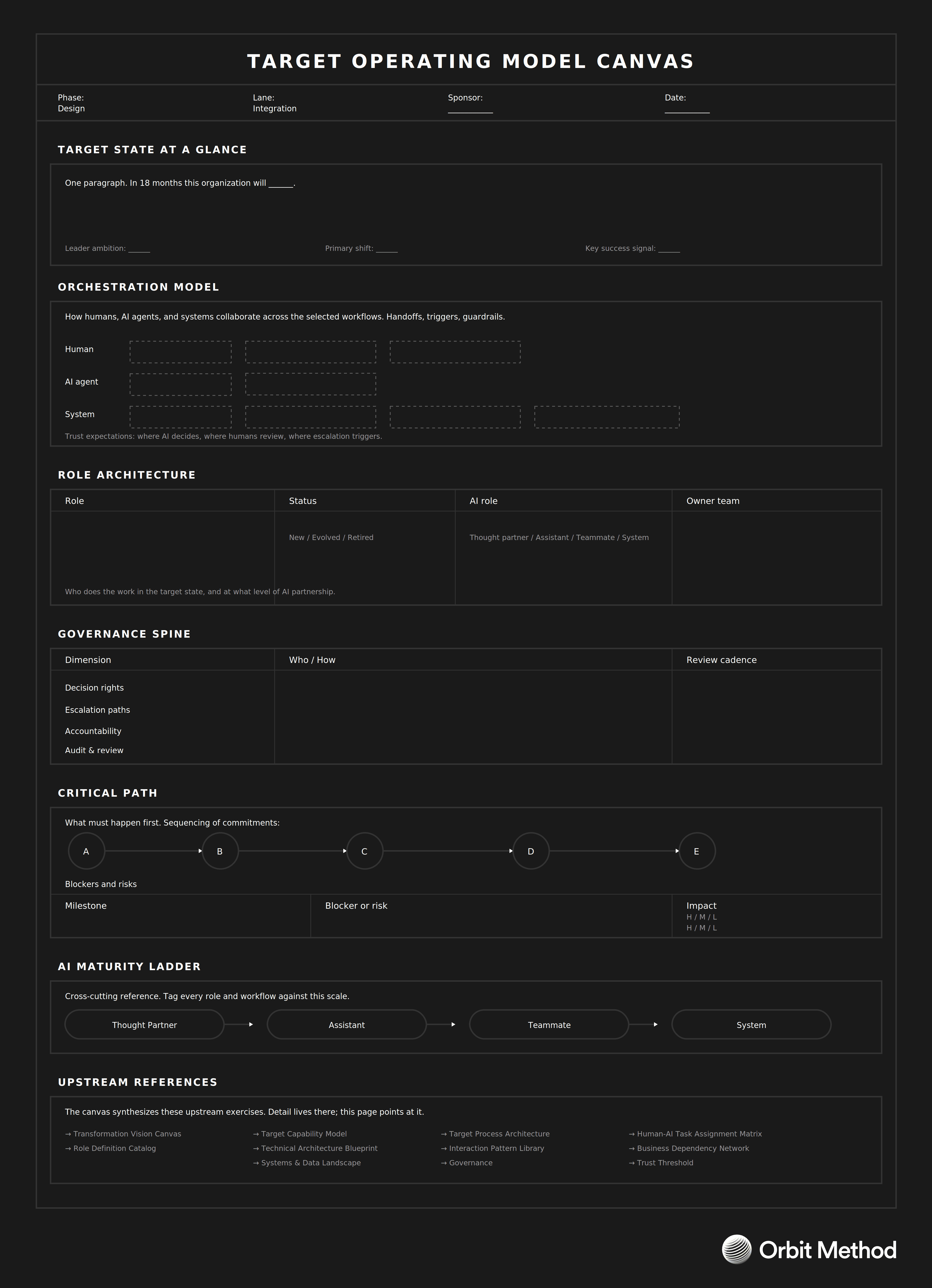
What the canvas shows
Target state at a glance opens the canvas with a single paragraph describing what this organization will be, do, and feel like once the transformation has landed, anchored by the AI Maturity Ladder ambition, the primary shift, and the key success signal.
Orchestration Model lays out how humans, AI agents, and systems collaborate across the selected workflows, with swimlanes for each and explicit handoffs, triggers, guardrails, and trust expectations.
Role Architecture names the roles in scope, marks each as new, evolved, or retired, and tags it against the AI Maturity Ladder to show at what level of AI partnership the role operates.
Governance Spine captures decision rights, escalation paths, accountability, and audit cadence in summary form. The shape of control lives here; the detailed controls live in Guide.
Critical Path sequences the milestones that must happen first, and lists the blockers and risks that stand in their way.
Running across the bottom, the AI Maturity Ladder serves as a cross-cutting reference, against which every role and workflow on the canvas is tagged.
Supporting detail lives in the upstream exercises the canvas points back to: capability maturity in the Target Capability Model, systems and data in the Technical Architecture Blueprint, interaction patterns in the Interaction Pattern Library, full dependency mapping in the Business Dependency Network.
Continue reading
Looking to contribute?
Orbit evolves through practice. Whether you're applying the method, testing ideas, or finding gaps, your experience helps refine it. Share what you're learning and help shape the next update.