Introduction
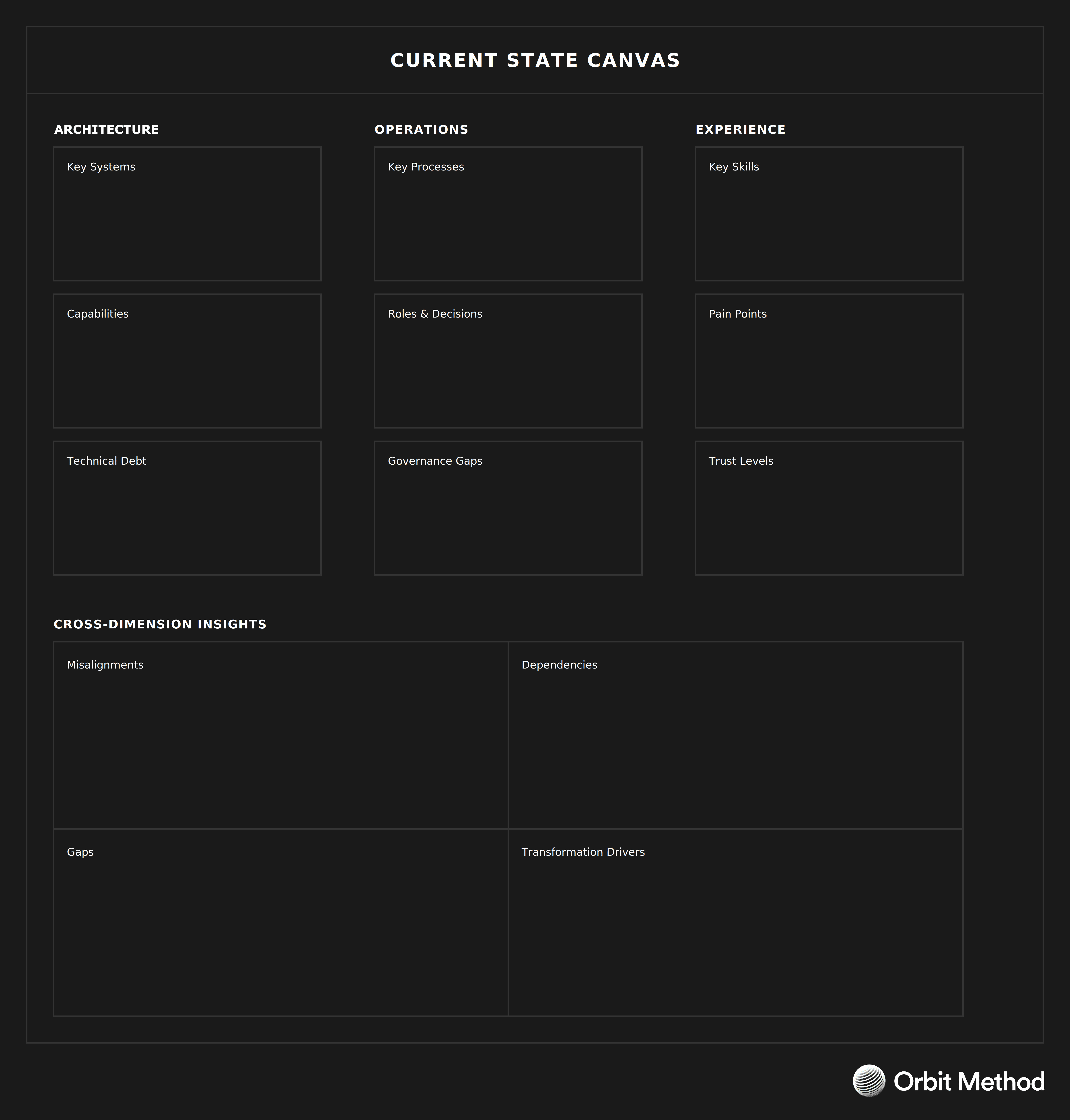
Before you can design the future, you need a shared view of today. The Current State Canvas brings together findings from all three lenses into one integrated snapshot, revealing where gaps exist, where the lenses are misaligned, and where there is already momentum to build on.
This canvas is the baseline half of the Map phase handoff into Design. Paired with the Transformation Vision Canvas, it answers the two questions every transformation needs resolved before design begins: where are we, and where are we going.
Phase | Map |
Lens | Integration |
Purpose | Create a unified baseline view across architecture, operations, and experience |
Output | Completed Current State Canvas |
Who's Involved | Enterprise architects, process owners, L&D leads, HR, UX designers, transformation lead |
Duration | 2 to 4 hours (synthesis workshop), after lens exercises complete |
When to use it
At the end of the Map phase, after the lens exercises across Architecture, Operations, and Experience are complete. The canvas is a synthesis, not a discovery, so do not start it before you have evidence to synthesize. Revisit it at the start of each Evolve cycle: the current state has moved since the last synthesis, and the canvas needs to reflect reality, not the memory of it.
Input and Outputs
Inputs (exercises that feed this one):
All Map phase lens exercises (Technical Architecture Assessment, Current Capability Model, Current Process Architecture, Stakeholder Observations, Current Skills Inventory, Experience Curve, etc).
AI Initiative Inventory and Maturity Assessment (the live AI baseline).
Stakeholder Matrix and Influence Map (who needs to validate the baseline).
Outputs (what this one feeds):
Transformation Vision Canvas (the vision responds to this evidence).
Target Operating Model Canvas in Design (the gap between current and target).
Value Assurance Dashboard in Guide (baselines come from here).
Steps
Gather outputs from the Architecture, Operations, and Experience lens exercises.
Identify themes and patterns across lenses.
Map interdependencies between lenses (where does an architecture gap cause an experience problem, etc).
Highlight gaps and misalignments.
Document key insights and transformation drivers.
Validate with cross-functional stakeholders.
Common Pitfalls
Starting the synthesis before the lens exercises are complete, which produces a baseline based on opinion rather than evidence.
Treating the canvas as a report rather than a working artifact. It is meant to be referenced in Design, not filed.
Hiding misalignments to keep the picture tidy. The misalignments are the most valuable finding.
Presenting only the architecture lens because it is the most documentable. The experience lens is where transformation succeeds or fails.
Template