Introduction
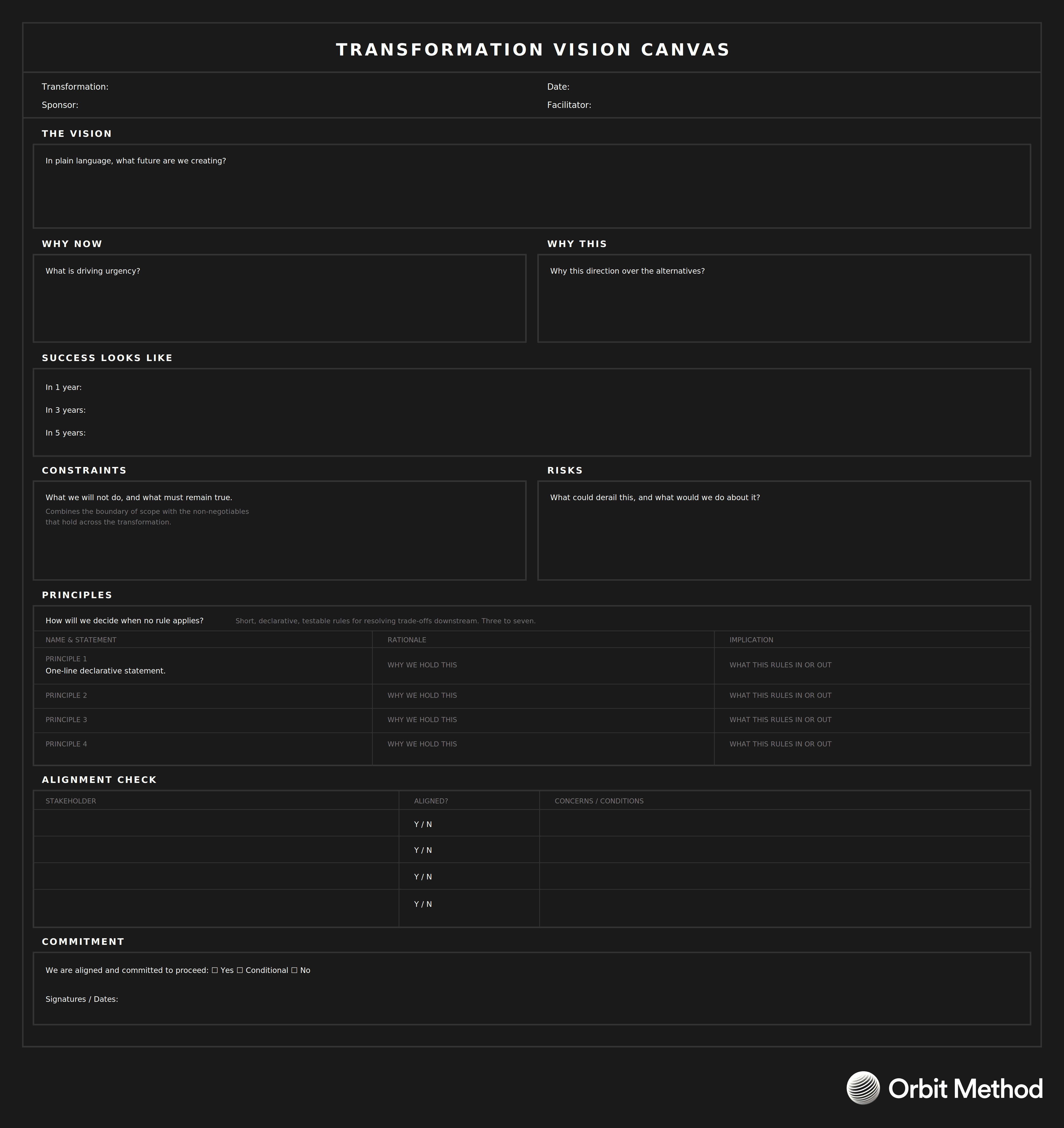
The Transformation Vision Canvas captures the direction, scope, boundaries, and decision rules of your transformation in one place. It is written at the end of Map, not the start, because vision gets sharper once you have understood your current state. Paired with the Current State Canvas, it is the handoff from Map into Design: where you are, where you are going, and how you will decide along the way.
Most transformation programs fail because they commit to a vision before they understand the organization. Orbit inverts this: you earn the right to a vision by mapping first. The same logic applies to principles. Rather than importing a generic set on day one, the canvas surfaces the few decision rules the organization actually needs to navigate its specific vision and constraints.
The canvas is a decision instrument, not a vision statement exercise. If a downstream design question cannot be resolved by pointing back at the canvas, the canvas was not specific enough.
Phase | Map |
Lens | Integration |
Purpose | Set the direction, scope, decision rules, and risks of the transformation, informed by what Map has surfaced |
Output | Transformation Vision Canvas, including a seed principle register |
Who's Involved | Transformation sponsor, program lead, two or three senior stakeholders representing the scope |
Duration | Half-day workshop |
What this is really for
The TVC is the vision alignment moment of the program. Not a slogan or a poster, but the working session where sponsors, leads, and senior stakeholders agree on direction, scope, what must remain true, and how they will decide. Everything in Design, Guide, and Evolve is tested against what this canvas commits to.
Programs that skip this conflate three different things in the same conversation: constraints (what we will not do), assumptions (what we are betting on), and principles (how we will decide when no rule applies). When they blur, every later design review reopens the same debate. The canvas separates them so the program has somewhere to point.
When to use it
At the end of the Map phase, after the lens exercises are complete and the Current State Canvas is drafted. Before entering Design.
Revisit at the start of each Evolve cycle to check whether the vision still holds, needs adjustment, or has been achieved.
Input and Outputs
Inputs (exercises that feed this one):
Strategic Context Map (why now, plus synthesized strategic intent from existing doctrine, strategy papers, and leader direction)
Current State Canvas (the evidence base the vision responds to)
AI Initiative Inventory and Maturity Assessment (the ladder ambition)
Stakeholder Matrix and Influence Map (who has to buy this vision)
Outputs (what this one feeds):
Target Operating Model Canvas in Design (the vision becomes concrete)
Operating Principles Catalog in Guide (the canvas principle register becomes the seed for operational principles)
Value Assurance Dashboard in Guide (success signals become measurable)
Transition Playbook in Evolve (the vision stays the reference point)
Steps
Articulate the transformation vision in plain language
Clarify the drivers: why now, why this over alternatives
Define what success looks like at 1, 3, and 5 years
Identify constraints: what we will not do, and what must remain true
Surface and resolve assumptions: harden into constraints, convert to risks, or park
Agree the guiding principles: three to seven decision rules, each with name, rationale, and implication
List the risks and the responses
Test alignment across stakeholders
Document and confirm shared commitment
Common Pitfalls
Writing the vision before the mapping is done, which produces generic AI-transformation boilerplate.
Treating the canvas as a vision statement exercise rather than a decision instrument. If a downstream design question cannot be resolved by pointing at the canvas, the canvas was not specific enough.
Mixing assumptions, constraints, and principles in the same conversation. They are different in kind: constraints are walls, assumptions are bets, principles are decision rules. Working on them as one pile produces wordsmithing instead of alignment.
Listing every possible success signal. Three to five anchors per horizon, not fifteen.
Adopting a generic principles list (often AI ethics boilerplate) instead of deriving principles from this specific vision and these specific constraints. Imported principles do not survive the first real trade-off.
Writing principles as values ("we believe in transparency") or as design choices ("federated, not centralized"). Neither resolves a trade-off. A principle tells you how to make the choice.
Skipping the ladder ambition, which leaves teams unclear whether they are building an assistant or redesigning the whole operating model.
Template